Introduction to SPV: Why Lightweight Clients Do Not Need to Download the Full Chain
SPV (Simplified Payment Verification) allows lightweight clients to verify that a transaction is included in a block without downloading the full blockchain. This article explains how SPV works, the role of Merkle proofs, what SPV can and cannot prove, and why SPV is a core capability in the BSV architecture.
First, Remember This One Sentence
SPV lets users verify that a transaction is included in a block without downloading and validating the entire blockchain.
SPV stands for Simplified Payment Verification. It is a concept introduced in the Bitcoin white paper and is also a crucial part of understanding BSV’s technical roadmap.
In large-scale on-chain application scenarios, not every user, wallet, web application, or small device is suited to downloading the full blockchain, validating every transaction, and maintaining the complete UTXO set. The value of SPV is that it allows ordinary users and applications to verify only “the transactions relevant to them,” rather than validating every transaction in the world.
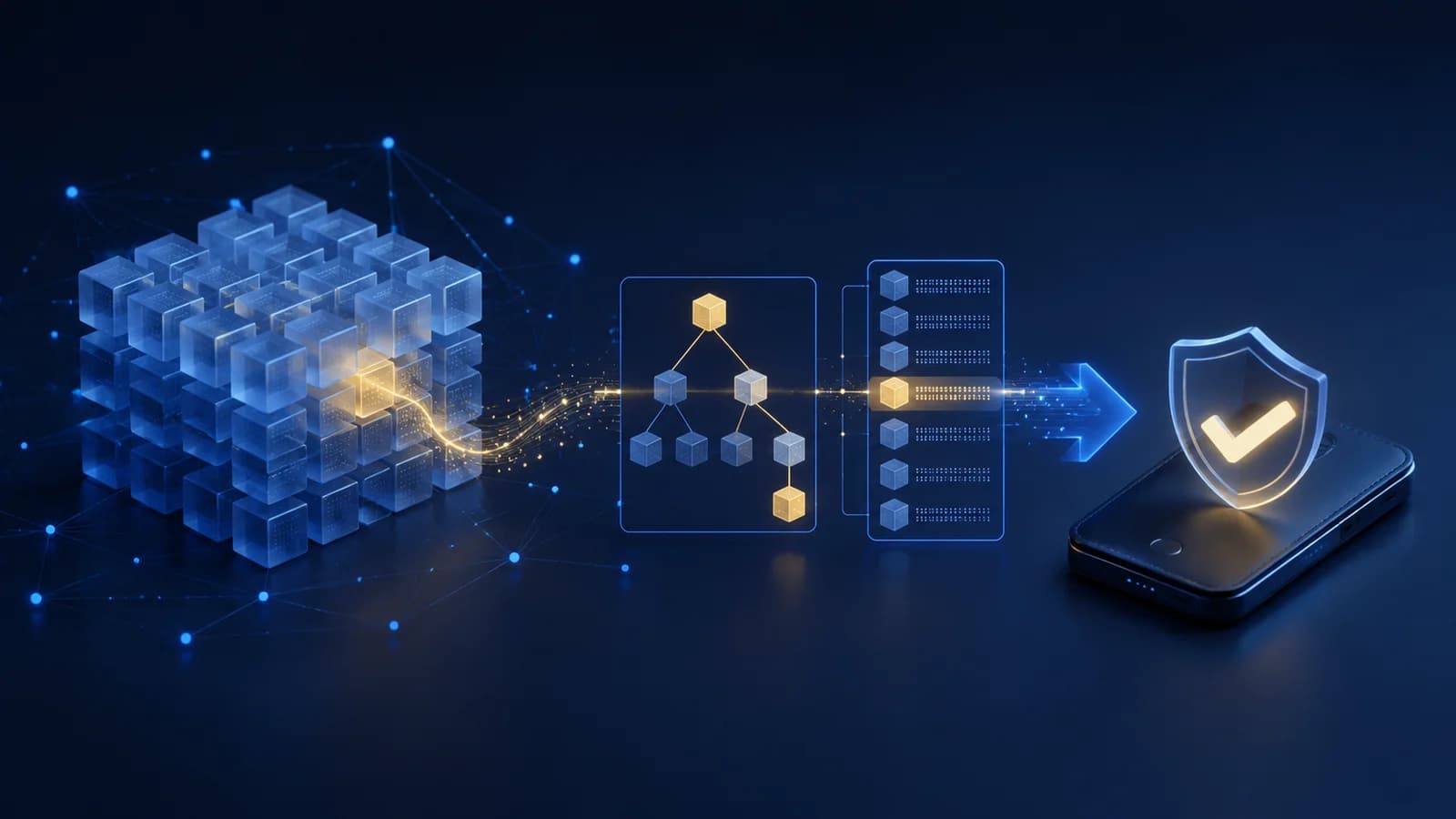
Why Do We Need SPV?
If every participant had to run a full node, many real-world use cases would become very difficult:
- Mobile wallets would need to continuously download and store large amounts of on-chain data;
- Web applications would have to bear validation costs at the level of a full node;
- Small devices would struggle to maintain the complete UTXO set;
- Enterprise applications would need to scan large amounts of data unrelated to their own business.
In most cases, however, users usually only care about a few questions:
- Does the transaction I received exist?
- Has it been included in a block?
- Is the block it is in part of a valid proof-of-work chain?
- Can I obtain enough evidence to prove this to someone else?
SPV is designed precisely for these questions. It does not require users to re-validate the entire history of the chain. Instead, it provides a lightweight way to verify the relationship between a transaction and a block, as well as the proof-of-work context of the chain that block belongs to.
What Materials Are Needed for SPV Verification?
A simplified version of SPV verification usually requires the following types of materials:
- The transaction itself
- Merkle proof / Merkle path
- Block header
- A sufficient chain of block headers
Each plays a different role:
- The transaction itself tells you what happened, such as the inputs, outputs, amount, locking script, and other details.
- The Merkle proof proves that the transaction is included in a particular block’s Merkle root.
- The block header contains that block’s Merkle root.
- The block header chain and PoW are used to prove that the block belongs to a chain with proof of work.
The key point is: you do not need to download all transactions in the entire block. As long as you obtain the proof materials related to the target transaction, you can complete the verification relevant to that transaction.
An Intuitive Explanation of Merkle Proofs
A block may contain many transactions. Miners do not put all transaction IDs directly into the block header. Instead, they use a Merkle Tree to hash these transactions layer by layer, ultimately compressing them into a single Merkle root.
If you want to prove that a transaction is in a block, you do not need to provide every transaction in that block. You only need to provide the set of “sibling hashes” necessary to trace the path from that transaction to the Merkle root.
This path is the Merkle proof, also commonly called the Merkle path.
The verification process can be understood in simplified form as:
If the final calculated Merkle root matches the Merkle root in the block header, it shows that the transaction was indeed included in that block’s Merkle tree.
What Can SPV Prove, and What Can It Not Prove?
SPV is very useful, but it is not magic. Understanding its boundaries is very important.
SPV Can Prove
- That a transaction is included in a particular block;
- That the block header belongs to a chain with proof of work.
SPV by Itself Cannot Fully Prove
- That the transaction inputs have absolutely not been double-spent globally;
- That you have personally and fully validated all scripts and UTXO state;
- That the other party’s business commitment is necessarily true.
Therefore, in real systems, SPV is usually used together with miner policies, transaction processors, block header services, wallet services, risk models, and application protocols. It solves the problem of lightweight verification; it does not replace all business risk controls or full-node validation.
Why Does BSV Place Special Emphasis on SPV?
BSV’s scaling roadmap holds that ordinary users and applications should not all have to run full nodes. Full nodes and miners can specialize in processing large volumes of transactions, while users, wallets, and applications verify the transactions they care about through SPV.
This is closely related to several technical directions in BSV:
- Large blocks: Blocks may become very large, making it unsuitable for ordinary users to download full blocks.
- Low fees: Large numbers of small-value transactions require a lightweight and scalable method of verification.
- Enterprise data: Applications usually care only about their own business transactions and should not need to scan the entire chain.
- Overlay Services: Application-level indexing layers can verify relevant transactions through SPV.
- SPV Wallet: Wallets store and exchange transaction proofs instead of relying only on central servers to return balances.
Therefore, in the BSV learning path, SPV is not an advanced elective topic. It is one of the core concepts for understanding its architectural design.
What Are BUMP and BEEF?
In the BSV ecosystem, two terms often appear when learning about SPV:
- BUMP: BSV Unified Merkle Path
- BEEF: Background Evaluation Extended Format
A simple way to understand them at first is:
- BUMP is a format for representing Merkle proofs;
- BEEF is a format for carrying transactions together with their verification background information.
Their shared goal is to enable wallets, applications, and services to exchange verifiable transaction data in a more standardized way.
As you study SPV Wallet and BRC standards further, BUMP and BEEF become more concrete and practical technical components.
Common Misunderstandings for Beginners
Misunderstanding 1: SPV Means No Verification
No. SPV is lightweight verification. It verifies transaction proofs relevant to the user, rather than validating every transaction across the entire chain.
Misunderstanding 2: SPV Is the Same as Querying a Block Explorer
It is not the same. Querying a block explorer essentially means trusting the result returned by a website. The goal of SPV is to let you obtain proof that you can verify yourself.
Misunderstanding 3: SPV Is Only for Beginner Wallets
That is also incorrect. In the BSV architecture, SPV is an important foundation for large-scale applications, overlays, wallets, and data protocols. It is not only for ordinary users; it also serves application systems that need verifiable data exchange.
Summary
The core idea of SPV is simple: users do not need to download the full chain in order to verify that transactions relevant to them have been confirmed in a block.
Through the transaction itself, Merkle proof, block header, and block header chain, SPV gives lightweight clients the ability to verify. For BSV, which emphasizes large blocks, low fees, and application-level scaling, SPV is an important mechanism connecting ordinary users, wallets, enterprise applications, and the miner network.
Understanding SPV also means understanding why BSV does not require every application to become a full node. Instead, through standardized proofs and lightweight verification, on-chain data can be used, transmitted, and verified at greater scale.
Collection
BSV Basics
Part 6 of 43
A curated series covering BSV, blockchain fundamentals, protocol capabilities, and ecosystem knowledge.
Previous part
How the BSV Network Works: Transactions, Blocks, Fees, and Miner Incentives
Next part
How BSV’s Roadmap Differs from BTC and BCH: Why It Emphasizes On-Chain Scaling, Low Fees, and Enterprise Data
Reading path
Progress 6/43
- 01Read articlePart 1
Why BSV Still Matters for Long-Term Settlement
A compact note on settlement design, data permanence, and why builders keep looking at BSV.
Apr 30, 20265 min read - 02Read articlePart 2
P2P Electronic Cash: What Is Peer-to-Peer Electronic Cash?
Peer-to-peer electronic cash is the starting point for understanding Bitcoin and BSV. It emphasizes transferring digital value directly through transactions, signatures, and a public ledger, rather than relying on central platform accounts. This article explains peer-to-peer, cash, double spending, UTXOs, and why BSV emphasizes low fees, high-frequency transactions, and on-chain data.
May 19, 202615 min read - 03Read articlePart 3
Timestamp Server: Why Is Blockchain a Time-Ordered Record?
Blockchain is not just a ledger; it is also a public time-ordering machine. This article explains what the timestamp server means in Bitcoin/BSV, the role of block height and confirmations, and the value of timestamps in double-spend prevention and data attestation.
May 20, 202615 min read - 04Read articlePart 4
Proof of Work: Why Can Miners Order Transactions?
Proof of Work uses a mechanism that is expensive to compute and cheap to verify, allowing miners to compete for new blocks in an open network and using accumulated work to determine the ordering of transaction history. This article explains how PoW works, why miners can order transactions, its security significance, and the miner-economic logic behind BSV’s focus on large blocks, low fees, and high transaction volume.
May 20, 20265 min read - 05Read articlePart 5
How the BSV Network Works: Transactions, Blocks, Fees, and Miner Incentives
This article explains the basic mechanics of the BSV network: how transactions are constructed, how blocks organize them, how miners are incentivized, and why BSV places special emphasis on low fees, large blocks, and high-throughput on-chain transactions.
May 20, 202615 min read - 06Read articlePart 6Current
Introduction to SPV: Why Lightweight Clients Do Not Need to Download the Full Chain
SPV (Simplified Payment Verification) allows lightweight clients to verify that a transaction is included in a block without downloading the full blockchain. This article explains how SPV works, the role of Merkle proofs, what SPV can and cannot prove, and why SPV is a core capability in the BSV architecture.
May 20, 202615 min read - 07Read articlePart 7
How BSV’s Roadmap Differs from BTC and BCH: Why It Emphasizes On-Chain Scaling, Low Fees, and Enterprise Data
BTC, BCH, and BSV all come from Bitcoin, but their technical roadmaps differ significantly. This article explains why BSV chooses a low-fee, high-volume, large-scale on-chain scaling approach, through the lenses of on-chain scaling, low fees, a stable protocol, SPV, enterprise data, and real-world challenges.
May 20, 202615 min read - 08Read articlePart 8
WIFs, Mnemonic Phrases, and HD Wallets: An Introduction to Key Management in BSV Wallets
WIFs, mnemonic phrases, and HD wallets all relate to key storage, recovery, and derivation, but they mean different things. This article explains their differences, the role of xpubs, and security practices for BSV wallets and application development.
May 20, 202625 min read - 09Read articlePart 9
What Is the Difference Between BSV Mainnet and Test Environments?
Mainnet carries real value, while test environments are for learning and development. This article explains the differences between BSV mainnet and test environments, common risks, SDK usage considerations, and practical environment-separation recommendations for project configuration.
May 24, 20265 min read - 10Read articlePart 10
A Wallet Is Not an Account System: BSV Wallets Manage Keys and UTXOs
A BSV wallet is not a traditional account system. There is no single on-chain balance field; instead, the wallet calculates balances and creates transactions by managing private keys, UTXOs, inputs, outputs, signatures, and related data. This distinction is essential for understanding change, multiple inputs, non-custodial wallets, and application authorization.
May 24, 202615 min read - 11Read articlePart 11
BRC-100: A Standard Interface Between Wallets and Applications
BRC-100 is an interface standard in the BSV ecosystem that describes how applications and wallets communicate. It emphasizes that applications express business intent while wallets retain control of keys, helping non-custodial applications request transaction creation, signing, and returned results in a safer and more consistent way.
May 24, 20268 min read - 12Read articlePart 12
What Is a Transaction Input? Understanding BSV Transaction Inputs and UTXO References
A transaction input is the funding source of a BSV transaction. It references a specific unspent output from a previous transaction and provides unlocking data. Understanding inputs helps explain the UTXO model, outpoints, double-spend conflicts, fee calculation, and transaction debugging.
May 26, 202615 min read - 13Read articlePart 13
Understanding BSV Transaction Outputs: Amounts, Locking Scripts, and UTXOs
A transaction output is a new unit of value created by a BSV transaction, usually consisting of an amount and a locking script. Outputs can represent payments and change, but they can also carry OP_RETURN data, token state, or business records. Understanding outputs, UTXOs, and output indexes is fundamental to understanding BSV transactions and application protocol design.
May 26, 202615 min read - 14Read articlePart 14
What Is a TXID? Its Role, Common Misunderstandings, and Design Tips in BSV
A TXID is the most common transaction identifier in BSV. It can be used to look up transactions, reference outputs, store business records, and build SPV proof flows. But a TXID identifies the whole transaction, not a specific output, and it does not mean the transaction is final. Real applications should store it together with the output index, status, raw transaction, and proof materials.
May 26, 202615 min read - 15Read articlePart 15
Understanding Change Outputs in BSV Transactions: Why They Must Be Explicitly Included
A change output is a key concept in BSV’s UTXO model: old UTXOs must be spent in full, and any unspent amount must be returned to the payer through a new output. This article explains how change works, how it relates to fees, change addresses, privacy, and practical UTXO management.
May 26, 202615 min read - 16Read articlePart 16
How BSV Transaction Fees Are Calculated: Total Inputs Minus Total Outputs
BSV transaction fees are not stored as a separate field. They are calculated as total inputs minus total outputs. Understanding this rule helps developers handle change correctly, estimate fees, manage UTXOs, and avoid accidentally turning remaining balance into fees.
May 26, 202615 min read - 17Read articlePart 17
What Is a Raw Transaction? The Basics of BSV Transaction Serialization, TXIDs, and Signatures
A raw transaction is the original byte representation of a transaction after protocol-compliant serialization, usually shown as a hexadecimal string. It is central to TXID calculation, signing, broadcasting, and debugging, and is a key concept for understanding how BSV transactions work at the protocol level.
May 26, 202610 min read - 18Read articlePart 18
Endian Issues in BSV Transaction Debugging: Why TXIDs Can Look Reversed
Endian is a common byte-order issue when debugging BSV transactions, especially in raw transactions, TXIDs, outpoints, numeric fields, and Merkle proofs. Understanding the difference between display format and serialized bytes helps avoid false “TXID mismatch” or “proof calculation failed” conclusions.
May 26, 202612 min read - 19Read articlePart 19
What Is a UTXO? Understanding the Foundation of the BSV Transaction Model
A UTXO, or “unspent transaction output,” is the basic unit of the BSV transaction model. A wallet balance is not an on-chain account field, but the sum of controllable UTXOs. Understanding UTXOs helps explain BSV inputs, outputs, change, fees, double-spending, Script, and parallel processing.
May 27, 202615 min read - 20Read articlePart 20
In BSV, Spending Means Consuming Old UTXOs and Creating New Ones
In BSV, spending does not update a balance. It consumes old UTXOs and creates new ones. Understanding this model helps explain payments, change, transaction chains, and the basic logic behind tokens and application state transitions.
May 27, 202612 min read - 21Read articlePart 21
One Address Can Have Many UTXOs: Understanding Addresses, Balances, and Transaction Construction in BSV
In BSV’s UTXO model, an address is not an account or a single balance slot. The same address can be associated with multiple UTXOs, and a wallet balance is simply the sum of those outputs. Understanding this is essential for transaction construction, fee handling, UTXO fragmentation, and privacy.
May 27, 20265 min read - 22Read articlePart 22
Why the UTXO Model Is Suitable for Parallel Processing – The Technical Foundation of BSV Scaling
The UTXO model splits state into independent outputs, allowing transaction verification to proceed in parallel, providing a key data structure foundation for BSV's on-chain scaling and high throughput. This article compares the account model with the UTXO model, explains the principles of parallelism, practical limitations, and its relationship with Teranode and application design.
Jun 2, 20264 min read - 23Read articlePart 23
Understanding Bitcoin Double Spend: Why the Same UTXO Cannot Be Spent Twice
Double spending is a core problem for digital cash systems. This article explains the principle, transaction structure, miner's role, 0-conf risk, signatures and double spend, and engineering best practices.
Jun 2, 20264 min read - 24Read articlePart 24
Understanding Locking Script in BSV: The Core Mechanism of Spending Conditions
Locking script is an essential part of a BSV transaction, defining the conditions under which a UTXO can be spent. This article starts from the basics, gradually explaining the location of locking scripts, their relationship with addresses, how they are expressed, and their importance in applications.
Jun 2, 20264 min read - 25Read articlePart 25
Deep Dive into Unlocking Script: The 'Key' to Spending Blockchain Transactions
Unlocking script is the unlocking material in a transaction input that satisfies the locking conditions of a previous output. This article comprehensively explains the concept, location, working principle, and common misconceptions.
Jun 2, 20264 min read - 26Read articlePart 26
P2PKH: BSV's Most Common Payment Script Template Explained
P2PKH (Pay to Public Key Hash) is the most basic payment script in Bitcoin/BSV. This article breaks down its core logic, workflow, relationship with addresses, unlocking conditions, and why BSV developers need to understand it.
Jun 2, 20264 min read - 27Read articlePart 27
OP_RETURN: A Beginner's Guide to Writing Data on the BSV Blockchain
Learn the basics of OP_RETURN, how it differs from regular payments, data format requirements, privacy considerations, and use cases.
Jun 2, 20263 min read - 28Read articlePart 28
Understanding Bitcoin Script: A Stack-Based Scripting Language and Its Execution Model
Bitcoin Script is a stack-based scripting language used to verify transaction spending conditions. This article starts with the concept of a stack, illustrates its execution process with examples, and explores key points such as P2PKH, restricted design, and BSV applications, helping readers understand the core mechanism of this on-chain verification language.
Jun 2, 20263 min read - 29Read articlePart 29
Standard Scripts vs Non-Standard Scripts: The Easily Overlooked Boundary in BSV Development
A transaction that is valid under consensus rules may not be processed by the network. Understand standard scripts and miner policies to avoid broadcast failures.
Jun 2, 20264 min read - 30Read articlePart 30
Getting Started with @bsv/sdk: Installation, Verification, and First Steps
Introduces the installation, project setup, and verification process for @bsv/sdk, helping developers quickly enter the BSV development environment and understand the SDK's role in the tech stack.
Jun 15, 20264 min read - 31Read articlePart 31
WalletClient: The Communication Entry Point Between Applications and Wallets
WalletClient is a standardized client for connecting wallets in BSV applications. It enables applications to describe transaction intent while the wallet handles authorization, signing, and UTXO management, thereby isolating complexities like private keys, UTXOs, and signing.
Jun 15, 20264 min read - 32Read articlePart 32
Creating Your First BSV Transaction with createAction(): A Beginner's Guide
createAction() is the core method in the BSV SDK, allowing applications to describe transaction actions via a high-level interface while the wallet handles signing, fees, and broadcasting. This article explains its principles, parameters, and practical usage.
Jun 15, 20264 min read - 33Read articlePart 33
Auto-Select Inputs, Change, and Fees: How the Wallet Builds a Complete Transaction for You
When using the high-level SDK, the wallet automatically selects spendable UTXOs, generates change outputs, and calculates fees. This article explains how this process works, its benefits, and potential risks.
Jun 15, 20264 min read - 34Read articlePart 34
Writing Data to the BSV Blockchain: From OP_RETURN to Application Protocols
BSV transactions can do more than transfer satoshis. By including data outputs, you can record text, hashes, or business events on-chain. This article starts with the first Hello BSV transaction, explains the difference between data outputs and payment outputs, how to construct an OP_RETURN using the SDK, the reason for hex encoding, and how to move toward structured protocol design.
Jun 16, 20264 min read - 35Read articlePart 35
Viewing BSV Transactions with WhatsOnChain: A Complete Guide from txid to On-Chain Structure
This article teaches you how to use the block explorer WhatsOnChain to view transaction details, understand core concepts like inputs, outputs, scripts, and fees, and leverage the explorer to infer the underlying logic of the SDK.
Jun 16, 20264 min read - 36Read articlePart 36
Getting started with BSV transactions: the right way to manually specify inputs
In BSV's UTXO model, manually specifying transaction inputs is a must-have skill for advanced development. This article explains the essence of inputs, the required information, code examples, and common pitfalls, helping you avoid the mental trap of "debiting an address."
Jun 18, 20264 min read - 37Read articlePart 37
Manually Specifying Transaction Outputs: A Key Step in Designing BSV Applications
Learn how Bitcoin transaction outputs work by constructing transactions manually. This article covers output types, change rules, index ordering, and common pitfalls, helping you advance from “sending transactions” to “designing BSV applications.”
Jun 18, 20263 min read - 38Read articlePart 38
Bitcoin Transaction Fees: Calculation, Influencing Factors, and Practical Guidelines for BSV
Transaction fees are not an explicit field but the difference between total inputs and total outputs. Understanding the fee calculation logic, factors affecting transaction size, and BSV network policies is essential for building on-chain applications.
Jun 18, 20264 min read - 39Read articlePart 39
Why Every Input in a Bitcoin Transaction Needs Its Own Signature
Understand the necessity of multi-input signatures in Bitcoin transactions, avoid common misunderstandings, and learn the basics of P2PKH signing, SDK usage, and what signatures actually protect.
Jun 18, 20264 min read - 40Read articlePart 40
BSV Transaction Serialization: From Object to Broadcast
Understanding transaction serialization is key to connecting application development with the blockchain network. This article explains why serialization is needed, the standard transaction structure, the role of hex, serialization and deserialization in the SDK, the relationship with txid, and common misconceptions, helping you move from calling the SDK to debugging on-chain data.
Jun 18, 20264 min read - 41Read articlePart 41
BSV Transaction Broadcasting: A Complete Guide from Construction to Submission
In BSV development, constructing a transaction is only the first step. This article explains the significance of transaction broadcasting, common misconceptions, pre-broadcast checks, how to interpret the return value, and failure reasons, helping developers correctly submit transactions to the network.
Jun 18, 20264 min read - 42Read articlePart 42
Transaction Chains: How a Transaction Spends a Freshly Created UTXO
To truly grasp the Bitcoin white paper's definition of a coin as a chain of digital signatures, you must understand transaction chains. This article starts from the simplest model to explain how UTXOs transfer between transactions and why transaction chains are essential for state management in BSV applications.
Jun 18, 20264 min read - 43Read articlePart 43
The Bitcoin Block Header: The 80‑Byte Foundation for SPV and Light Clients
The block header is an 80‑byte summary of a Bitcoin block. It does not contain full transactions, yet it is the critical structure linking the proof‑of‑work chain and committing to the transaction set. This article explains the header fields, Merkle root, and SPV principles, helping you understand how BSV enables massive scaling.
Jun 20, 20265 min read
Recommended articles
 Blockchain
May 20, 2026
How BSV’s Roadmap Differs from BTC and BCH: Why It Emphasizes On-Chain Scaling, Low Fees, and Enterprise Data
BTC, BCH, and BSV all come from Bitcoin, but their technical roadmaps differ significantly. This article explains why BSV chooses a low-fee, high-volume, large-scale on-chain scaling approach, through the lenses of on-chain scaling, low fees, a stable protocol, SPV, enterprise data, and real-world challenges.
 Blockchain
May 20, 2026
How the BSV Network Works: Transactions, Blocks, Fees, and Miner Incentives
This article explains the basic mechanics of the BSV network: how transactions are constructed, how blocks organize them, how miners are incentivized, and why BSV places special emphasis on low fees, large blocks, and high-throughput on-chain transactions.
 Blockchain
May 20, 2026
WIFs, Mnemonic Phrases, and HD Wallets: An Introduction to Key Management in BSV Wallets
WIFs, mnemonic phrases, and HD wallets all relate to key storage, recovery, and derivation, but they mean different things. This article explains their differences, the role of xpubs, and security practices for BSV wallets and application development.